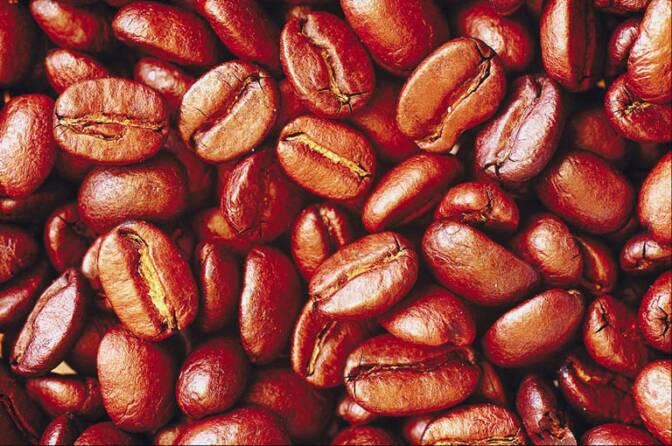
Coffee roasting is both a physical and chemical process. Physically we see the coffee beans change color, swell in size and become less dense as they lose about twenty percent in weight.

Simultaneously, there is a change in molecular chemistry that creates the aromas and flavor constituents we so appreciate in the cup.

The reason there is such great variation in coffee flavors is because we are dealing with a seasonal commodity that has an astounding number of molecular compounds  more than any other food or beverage  and a heating process that directly contributes to the final flavor, more than any other cooking method.
The flavor of a coffee is determined by the natural potential that is in the beans and shaped by the way it is roasted. Green coffee traders have long been aware that all beans are not created equal. The best high-grade coffees are rare and much sought after. Consequently they are more costly.

Regarding the roasting; simply put, it is a time-temperature process that would be more straightforward if we were just baking a cake. A cake requires pre-heating the oven and baking for a prescribed length of time at a particular temperature. We can estimate when it's ready after we check to see if it's cooked throughout. Coffee, on the other hand, is roasted to color. Without instrumentation to assess the color it must be roasted by eye or to a particular temperature or for a determined amount of time.

The coffee roasting process is far more complicated than baking. Yet like baking you can bake fast or slow. Normal roasting is based on the time it takes for the beans to absorb the heat evenly throughout the beans. A gentle approach produces a normal roast with expected results. Although is not uncommon to roast about twenty percent faster or slower to produce variation in the taste of the coffee.
Say a standard roast takes twelve minutes for a standard taste. A faster roast of maybe ten minutes would give a brighter and cleaner taste to the coffee. Such a coffee is better for drip brewers. A slower roast of about fourteen minutes is better for espresso because it will likely give a smoother and heavier taste to the cup. This fine-tuning can be accomplished by controlling the heat and airflow during roasting.

Roasting is necessarily complex in its chemistry. This is because the myriad of natural compounds found in coffee beans is considerably altered in the roasting process. As coffee beans heat up, certain complex compounds breakdown and are degraded into simpler compounds, which in turn will re-combine into other compounds creating the variation in the flavor and aroma components of the finished product.

The rate of heating the beans is but one of the ways the taste of a coffee can be manipulated. The pre-heat temperature, rate of increasing the temperature and alterations in the airflow can all have an effect on the final taste. A roastmaster will select the control parameters of time and temperature, which determines the profile of the roast.

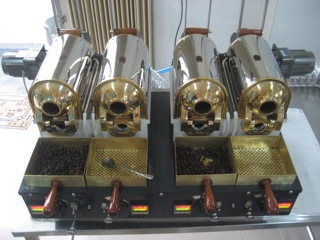
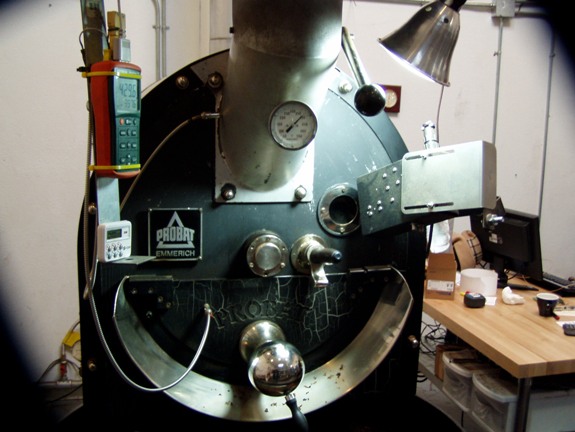
All commercial roasting machines manufactured today are equipped with a computer controller that allows the operator to pre-select and control the heat and airflow throughout the roasting process. Some are able to track previous time/temperature profiles in order to duplicate previous roasts. Unfortunately all these systems only work on duplicating time and temperature routines whereas Fresh Roast Systems actually tracks the color development that encompasses all other variables.

If all coffees were the same a time/temp profile would suffice for producing consistency. Unfortunately this is not the case, so we roast to bean color which is a much more dependable approach to consistency in flavor.
There are several other factors that affect how a coffee roasts; moisture content, bean size, density and freshness. Some flavor notes are determined by the elevation at which the coffee is grown as well as climate conditions and soil composition. You have probably heard the promotions touting the merits of Mountain Grown and Volcanic Soil.

The Country of Origin makes a major contribution to the flavor of a coffee. A Sumatran coffee will taste dramatically different from a Colombian or Ethiopian. Experience has taught us that a Sumatran generally tastes better at a dark roast, Colombian at a light roast and Ethiopian usually at a medium roast.

We do not know in advance exactly what temperature will yield the desired degree of roast for each coffee. This is why a Color Track Laser system is used on Fresh Roast Machines to electronically read the developing roast color throughout the process and stop the roast automatically at the desired degree of roast regardless the temperature.


                                                                                                  FRESHROAST SYSTEMS
COFFEE COLOR AND ROAST DEGREE
TECHNICAL & SALES SUPPORT

TOLL FREE            (866) 244-1578
INTERNATIONAL  (804) 435-5522
HOURS                   9:00 AM - 6:00 PM EST    M-F
This page was last updated: February 2, 2010
593 Holly Haven
Weems Va 22576
Tel (804) 435-5522 Toll Free (866)-244-1578 Fax (703) 991-7133
www.coffeelabequipment.com
NEW !
Check these out!
PROFESSIONAL LABORATORY INSTRUMENTATION FOR COFFEE, TEA, COCOA AND AGRICULTURE
www.coffeelabequipment.com
COLOR
MOISTURE
OXYGEN
PARTICLE SIZE
SOLIDS TESTING
Tell a friend about this page