In the import and export arena of the coffee sector, moisture levels in
coffee are important, not only because they have an impact on storage considerations, but becuase coffee is most often bought by the pound. A pound of coffee at 14% moisture may not be as good a value as the same coffee at 10% moisture, especially in large quantities.
Roasters also need to know the moisture level in green coffee, prior to roasting. Roast profile software is now standard with most commercial roasters, but if you apply the same program to samples with different moisture levels, the resulting product will be different. To attain true repeatiblility, all variables need to be eliminated.
Since the Oven Method is too cumbersome to be practical, for routine testing of moisture, other methods are generally used.
THERMOGRAVIMETRICS
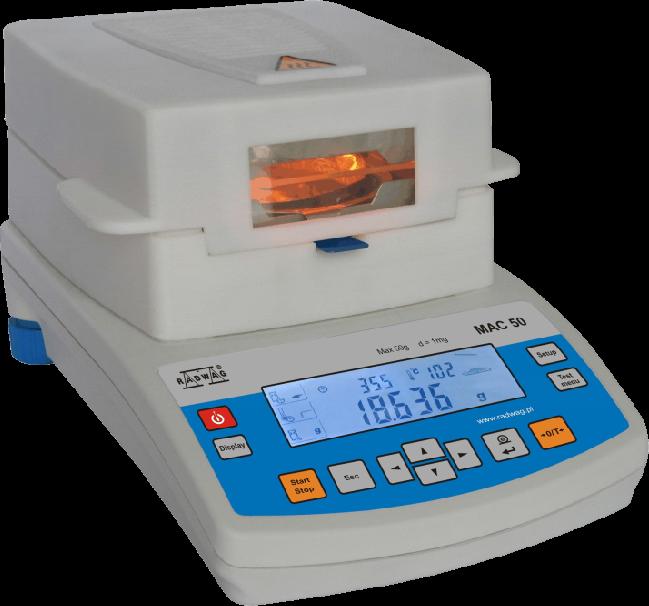
The most versatile oven alternative method (CAN BE USED FOR ROASTED AND INSTANT COFFEE TOO), is thermo-gravimetrics. Here the sample is heated, and weighed simultaneously, in a moisture balance.
There are different heat sources, the most common being halogen. This inexpensive PMC 50 Moisture Balance, will accept about 6-7 grams of sample. Since the sample is ground for analysis, when using a moisture balance, any thing more than 6-7 grams, gets piled too high for effective drying, on a 3 inch diameter pan.
MOISTURE DETERMINATION IN COFFEE
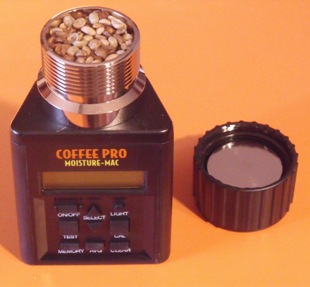
Low cost field analyzers like this COFFEE PRO MOISTURE MAC are an inexpensive, but effective way, to ensure coffee moisture levels are adequate for shipping Moisture levels of between 8 and 13% are recommended for safe transportation and storage of coffee. (Clarke, 1985; Reh, Gerber, Prodolliet, & & Vuatez, 2006)
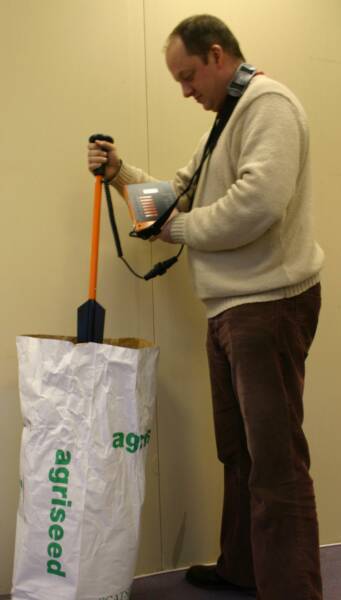
THE SINAR SPEAR MOISTURE ANALYZER, TRANSMITS A SMALL RF FIELD THE SIZE OF A SOCCER BALL, AND USES THAT AS THE ASSUMPTION OF THE SAMPLES MASS. THE SAME TECHNOLOGY IS USED FOR THE SINAR DRYPRO INLINE MOISTURE ANALYZER
BOTH ARE CAPABLE OF TRANSMITTING CONTINUOUS MOISTURE MEASUREMENT
ALL RIGHTS RESERVED
589 Rappahannock Drive WhiteStone Va 22578
Tel (804) 435-5522 Toll Free (866) 244-1578 Fax (703) 991-7133
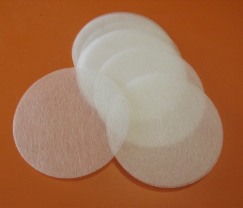
BY THE OPERATOR. DEPENDING ON THE ACCURACY REQUIREMENTS OF THE TEST, AN ANALYSIS CAN USUALLY BE COMPLETED IN 10-15 MINUTES. HIGHER TEMPERATURES CAN BE USED, IF GLASS FIBER PADS ARE EMPLOYED TO HELP PROTECT THE SAMPLE FROM SURFACE BURN.
BECAUSE ROASTED COFFEE IS DARK,
AND ALL COFFEE CONTAINS VOLATILES,
CARE HAS TO BE TAKEN NOT TO BURN
THE SAMPLE, WHICH RESULTS IN FALSE RESULTS.
THESE GLASS FIBER PADS ALLOW THE
OPERATOR TO USE HIGHER TEMPERATURES, THEREBY REDUCING THE TIME REQUIRED FOR A TEST.
LOSS ON DRYING
CAPACITANCE
The most popular method for routine testing of moisture in agricultural commodities, takes advantage of the electrical properties of water, to provide a usably accurate reading, with tolerances ranging between.1%, and .5%.
Here, a small rf signal is transmitted in to the sample, and the amount of energy retained in the sample (CAPACITANCE) is measured, which directly correlates to the amount of present moisture.
Besides speed, (1-10 Seconds per test) one of the primary benefits in using the capacitance method to measure coffee moisture, is that the sample generally requires no preparation, which saves time and money.
UNIFORM PACKING DENSITY IS A REQUIREMENT FOR USING CAPACITANCE TO SUCCESSFULLY MEASURE A COMMODITIES MOISTURE. THIS COFFEE PRO MOISTURE MAC, USES A FIXED VOLUME SAMPLE CELL TO DETERMINE THE SAMPLES MASS, AND A COMPRESSION CAP TO FACILITATE UNIFORM DENSITY. BECAUSE NOT ALL COFFEE BEANS ARE THE SAME SIZE, AND THEREFORE HAVE SLIGHTLY DIFFERENT PACKING DENSITIES, THE PUBLISHED TOLERANCES FOR THIS TYPE OF COFFEE MOISTURE ANALYZER,, IS +/- .5%
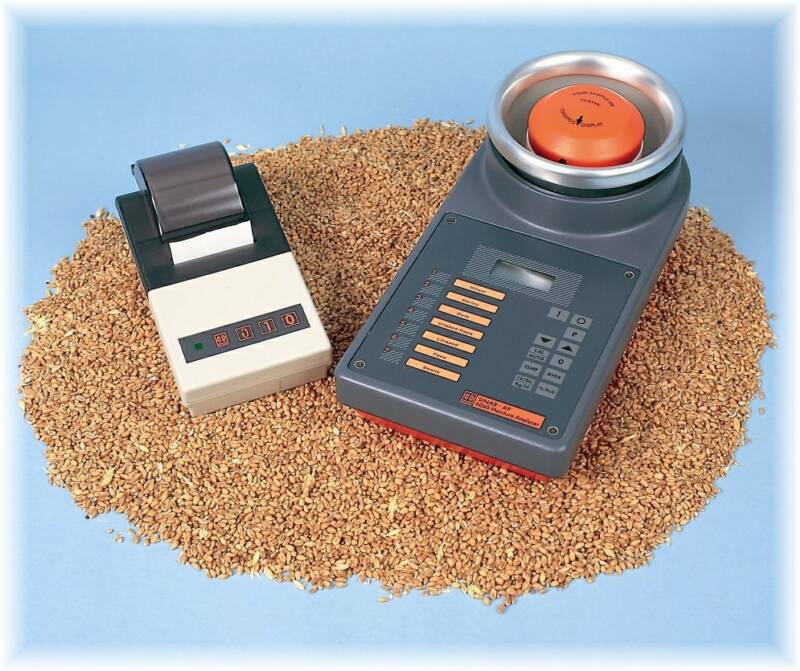
THE SINAR AP 6060 COFFEE MOISTURE ANALYZER, USES A BALANCE TO DETERMINE MASS.
BECAUSE IT DOES NOT USE A COMPRESSION CAP,
SAMPLES LIKE ROASTED WHOLE BEAN COFFEE, AND ROASTED GROUND COFFEE, CAN BE ANALYZED.
GROUND COFFEE IS SEPARATED IN TO COARSE, MEDIUM, AND FINE, TO ALLOW FOR DIFFERENT DENSITIES.
MOISTURE, PARTICLE CHARACTERIZATION, COLOR, AND SAMPLING
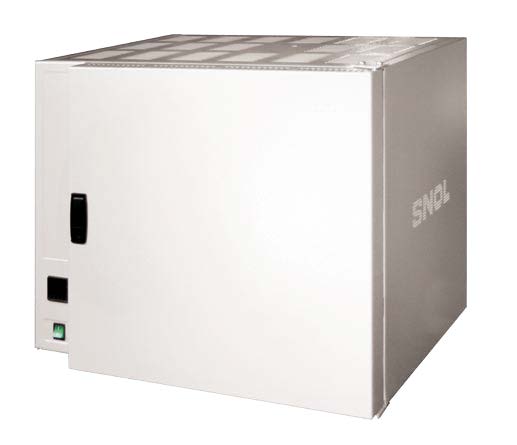
The official method for determining moisture levels in green coffee, is carried out by heating a sample of whole beans in an oven, until the beans are dehydrated. The test takes up to 24 hours to complete, because the oven must be kept at a low temperature (105 c) , in order to help prevent the loss of volatiles (oils and other organic compounds). Some volatiles will inadvertently get burned off however, which is why the method is called loss of mass, as opposed to loss of moisture.